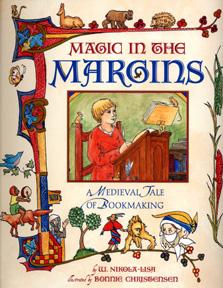
| Magic in the Margins:
Bookmaking in the Middle Ages
Bonnie Christensen, Illus.
Houghton Mifflin, 2007
Upper Elementary Grades
This piece of historical fiction for the upper elementary school reader follows young Simon, an orphan, who shows up at the door of a cathedral school one day. He is assigned to the writing room, i.e., the scriptorium, where he learns the ins and outs of an illuminated manuscript. His secret goal is to become an illuminator himself, and he does with the help of the head of the scriptorium. Beautifully illustrated using medieval manuscript motifs by Bonnie Christensen.
|
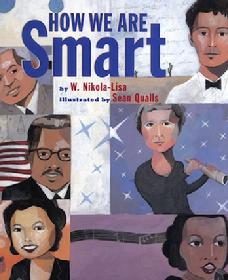
| How We Are Smart
Sean Qualls, Illus.
Lee & Low Books, 2006
Upper Elementary Grades
How We Are Smart presents Harvard neuropsychologist and cultural historian Howard Gardner's theory of Multiple Intelligences. Told through two sets of texts—a read-aloud poem and a block of information text—the book features 12 individuals (six men and six women from a variety of ethnic/racial groups), asking two questions. The first question addresses how the 12 individuals are "smart" based on Gardner's MI theory, and ends with the question, How are you—i.e., the young reader—smart? The book ends with several pages of notes, definitions, and teacher resources.
A Christopher Award recipient and a Myers Gustafus honor book. For his artwork, Sean Qualls won several awards, including an honorable mention by the Society of Illustrators.
|
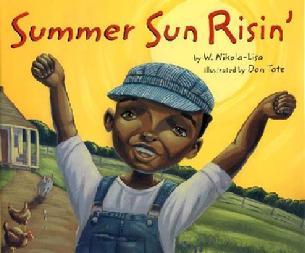
| Summer Sun Risin'
Don Tate, Illus.
Lee & Low Books, 2006
Primary Grades
Summer Sun Risin' follows a family of color through their daily farm chores, with much of the focus on the relationship between father and son. The arc of the book follows the 12 hour day from sunrise to sunset (with a last page hinting at the start of a new day). An astute reader will notice how award-winning illustrator Don Tate uses the Sun to track the day's activities.
"The rhythmic verses beg to be read aloud, and the colors and typeface are bold enough for group sharing. A cheery introduction to farm life and simple poetry." Kirkus Reviews
"This is a nicely designed book, from its endpapers (saffron at the beginnnig, cobalt at the end) to its simple, homespun typeface. It truly conjures up a lovely summer's day on a farm, and can be used during storytimes or as a cozy, one-on-one bedtime story." School Library Journal
Recipient of a State of Indiana Hooiser Award for Literary Excellence and a Banks Street College "Best Books" selection.
|
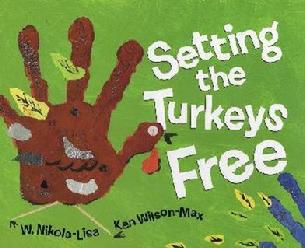
| Setting the Turkeys Free
Ken Wilson-Max, Illus.
Jump at the Sun/Hyperion, 2004
Primary Grades
Although the context is Thanksgiving, this is far from your typical Thanksgiving book. A young boy's imagination is let loose one day as he makes Thanksgiving "turkeys" using a variety of mixed media. Everything is going great, until Mr. Fox shows up—and he's hungry. The rest of the book is the young protagonist doing everything he possibly can to keep Mr. Fox away from his turkeys. You'll delight in this "keystone cops" adventure, especially at the hands of the talented British illustrator Ken Wilson-Max.
|
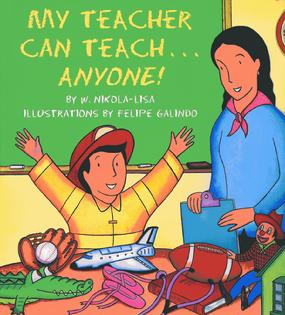
| My Teacher Can Teach...Anyone!
Felipe Galindo, Illus.
Lee & Low Books, 2004
Primary Grades
An alphabet book of professions that runs the gamut, from Astronaut, Ballet Dancer, and Carpenter to Xylophonist, Yodeler, and Zillionaire (no, I wasn't thinking of Elon Musk in the early 2000s). It all starts with a boy ruminating about his teacher: "My teacher is so good, she could teach...anyone!" After going through the entire alphabet of possibilities, the boy takes time to reflect in his daily school journal:
Yes, my teacher is so good,
she can teach anyone!
And that makes me happy
because this year...
she is teaching ME!
|
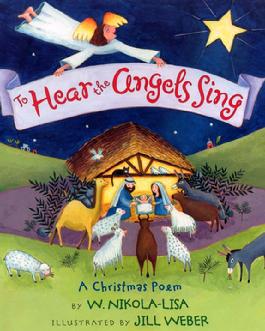
| To Hear the Angels Sing:
A Christmas Poem
Jill Weber, Illus.
Holiday House, 2002
Primary Grades
Based on the traditional song "Mary Had a Little Lamb," to Hear the Angels Sing takes you step-by-step (or, should I say, verse-by-verse) through Jesus's nativity, beginning with the authoritative biblical voice: "It came to pass that Mary gave birth to the Son of God..."
From there the reader is invited to sing along...
She gave Him birth in Bethlehem,
Bethlehem, Bethlehem.
She gave Him birth in Bethlehem,
among the hay and sod.
"A homespun poem and buoyant paintings tell the story of the very first Christmas in this jubilant picture book." Publisher's inside-flap description
|
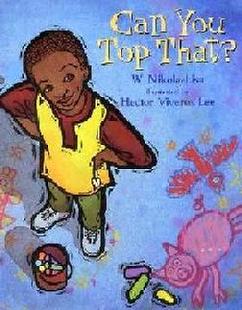
| Can You Top That?
Hector Viveros-Lee, Illus.
Lee & Low, 2000
Primary Grades
Oh, boy, does this fantasy get out of hand—from "I've got a fish with one fin..." to "I've got a dog with six ears..." to "I've got a horse with ten heads..."
It's a story of swagger and bravado among youngsters and it will tickle your funny bone as it sprials out of control. Out of control, that is, until the original narrator, a preschooler drawing chalk animals on the sidewalk, brings it all back down to earth.
Spunky, imaginative paintings by Hector Viveros-Lee will invite young readers to make their own counting book of hilariously funny animals. A real crowd pleaser.
|
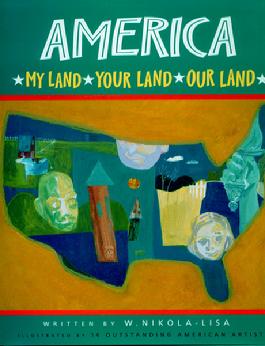
| America: My Land, Your Land, Our Land
Illustrated by 14 Artists of Color
Lee & Low Books, 1997, 2000
Hardcover: Upper Elementary Grades
Bilingual Board Book: Preschool/Primary Grades
Fourteen artists of color contribute their unique take (both conceptually and materially) on this quiet, meditative poem about the ethnic, racial, and social diversity of America. Written in brief couplets of contrasting ideas (i.e., Rich land/Poor land, Young land/Old land, Straight land/Round land, etc.). It's Hegel's thesis/antithesis/synthesis squeezed into a child's picture book, which culminates in...
My land/Your land/Our land
America, the beautiful
|
| The Year with Grandma Moses
Paintings by Mary Anna Robertson
(a.k.a. Grandma Moses)
Holiday House, 2000
Upper Elementary Grades
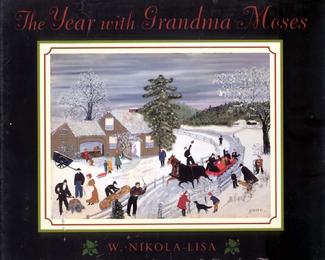
Come along on this seasonal journey with mid-20th-century American painter Mary Anna Robertson, a.k.a. Grandma Moses, as she both tells (through excerpts from her journals) and paints (through her naive oil paintings) the story of her life using the change of seasons as the pivot point. You'll enjoy both her paintings and descriptions of farm life, especially as she does chores, plays with her children, and taunts her husband (who's as good a sport as anyone when it comes to the various shenanigans portrayed).
When asked which book best represents Grandma Moses's life and work, heirs to the Grandma Moses Foundation picked The Year with Grandma Moses—hands down!
|
| Hallelujah: A Christmas Celebration
Cynthia Saint James, Illus.
Atheneum, 2000
Primary Grades
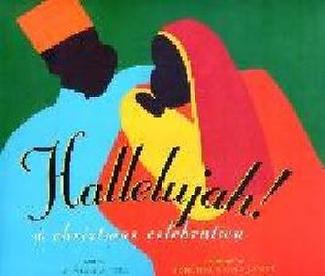
The glorious, color-drenched paintings of Cynthia Saint James accompany this unique take on the nativity story—the birth of a black baby Jesus. Thinking of the Black Madonna of Eastern European heritage, the racial and ethnic makeup of people from the Middle East, and the possible immigration of the "holy family" from North Africa, the author explores the possibility of a black baby Jesus using various literary techniques, i.e., an evolving set of collective nouns, a complementary color scheme embedded in each verse, and a droning refrain at the end of each double-spread page, "And a Black Baby Jesus." The verses in this almost prayer-like poem culminate with a resolute, "Amen," making Hallelujah truly a Christmas celebration.
|
|
|